Under FDA Food Code guidelines and manufacturer specifications (Manitowoc, Hoshizaki, Scotsman), commercial ice machines must undergo a professional cleaning, descaling, and sanitization at least once every six months. However, in Florida’s high-humidity coastal environment with airborne yeast (bakeries, breweries) and Pinellas County’s mineral-heavy municipal water, high-volume beach bars and restaurants should descale and sanitize their machines every 3 to 4 months to prevent health violations and costly harvest failures.
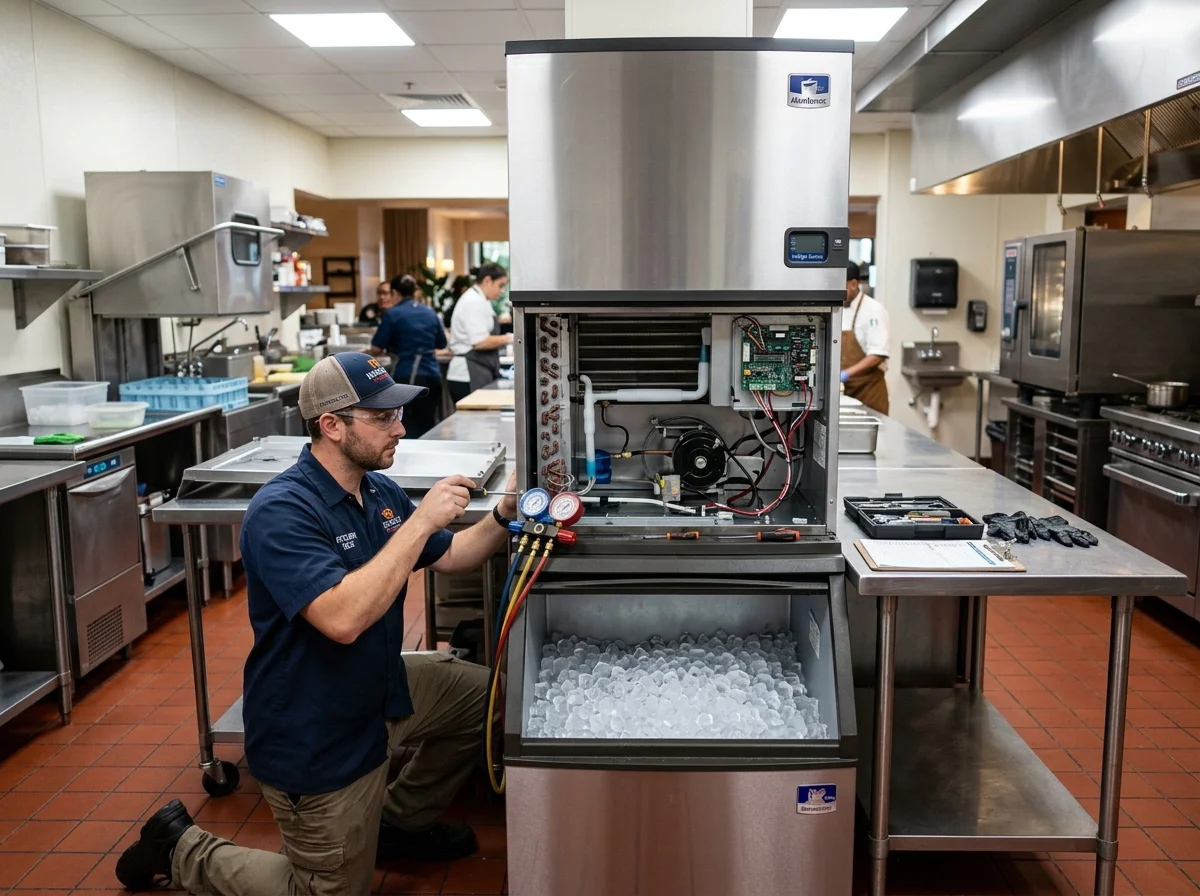
Ice is legally classified as a food product by the FDA. Yet in busy commercial kitchens throughout Clearwater Beach and downtown Clearwater, the ice machine is frequently the most neglected piece of equipment until the health inspector flags it or the machine stops producing ice on a busy Friday night.
Why Florida’s Climate Accelerates Ice Machine ContaminationCommercial ice makers in the Tampa Bay region face two intense environmental challenges:
- Pinellas County Hard Water Scaling: High concentrations of calcium and magnesium carbonate form an insulating chalky scale on evaporator freeze plates. When scale coats the metal, heat transfer fails. Harvest cycles take twice as long, cube shapes become deformed, and the machine often errors out on safety timers.
- Airborne Slime & Yeast: Yeast spores from open beer taps, pizza dough prep, and fruit garnishes are pulled directly into the damp ice bin through air intakes. Combined with 85%+ outdoor humidity, pink bacterial slime and black mold colonize the water curtain and distribution tubes rapidly.
Recommended Commercial Maintenance Schedule
| Frequency | Required Task | Responsible Party |
|---|---|---|
| Daily / Shift Change | Wipe down bin doors, sanitize scoop, store scoop in external holder | Kitchen Staff |
| Every 2 Weeks | Rinse removable air filters; check water pressure gauge | Shift Manager |
| Every 6 Months (Standard) | Nickel-safe acid descaling, EPA-registered sanitizing, water filter cartridge replacement, condenser fan coil wash | Certified Refrigeration Tech |
| Every 3 Months (High-Volume Bars) | Full acid flush and sanitization for beach bars and bakeries | Certified Refrigeration Tech |
Beyond failing Florida Department of Business and Professional Regulation (DBPR) health inspections, mineral buildup causes mechanical breakdowns:
- Burned Water Pumps: Scaling freezes magnetic impellers, overheating the motor winding.
- Evaporator Plate Delamination: On nickel-plated copper evaporators (such as Manitowoc), severe lime scale bonds with the metal, ripping the nickel plating off during harvest and causing permanent, unrepairable freon leaks.
- Water Valve Leaks: Calcium flakes lodge in the solenoid rubber diaphragm, preventing the valve from shutting completely and overflowing the water reservoir.
Explore our dedicated commercial ice machine repair services or call (727) 387-0008 to schedule a complete preventive maintenance visit for your venue.
Florida DBPR and FDA Food Code mandate commercial ice machine cleaning and sanitizing at least once every 6 months, with monthly deep cleanings recommended in coastal high-humidity environments.
Slimy biofilm (slime mold), calcium scale, and bacterial pathogens contaminate ice cubes, leading to immediate health code inspection citations, customer illness, and costly evaporator plate replacement.
Descaling uses food-grade, nickel-safe acid to dissolve hard mineral lime scale; sanitizing uses an EPA-registered sanitizing agent to eradicate bacteria, yeast, and slime mold.
Need Commercial Ice Machine Service?
24/7 commercial emergency dispatch available across Clearwater and Pinellas County.
Call (727) 387-0008 Now