Updated September 2026 • Clearwater, Pinellas County, FL
A refrigerator that freezes food is usually set too cold, has food blocking the cold-air vent, or has a stuck air damper, failed temperature sensor (thermistor) or thermostat letting too much freezer air in. The fridge should sit at 37°F (at or below 40°F). Most repairs cost $120 to $300.
Need help now? Call (727) 387-0008.
Check These First
- Setting: set the fridge to 37°F (or the middle of a 1–9 dial) and wait 24 hours.
- Thermometer: put an appliance thermometer in a glass of water on the middle shelf; it's more accurate than the display.
- Vents: move food away from the vent where cold air enters from the freezer, usually at the back top of the fresh-food section.
- Fast/Quick Cool: make sure a "Power Cool" or "Fast Cool" mode isn't left on.
- Load: a nearly empty fridge swings colder; a few water jugs help stabilize it.
If That Doesn't Fix It
| Cause | What happens | Typical cost |
|---|---|---|
| Air damper stuck open | Freezer air pours into the fridge nonstop | $130–$280 |
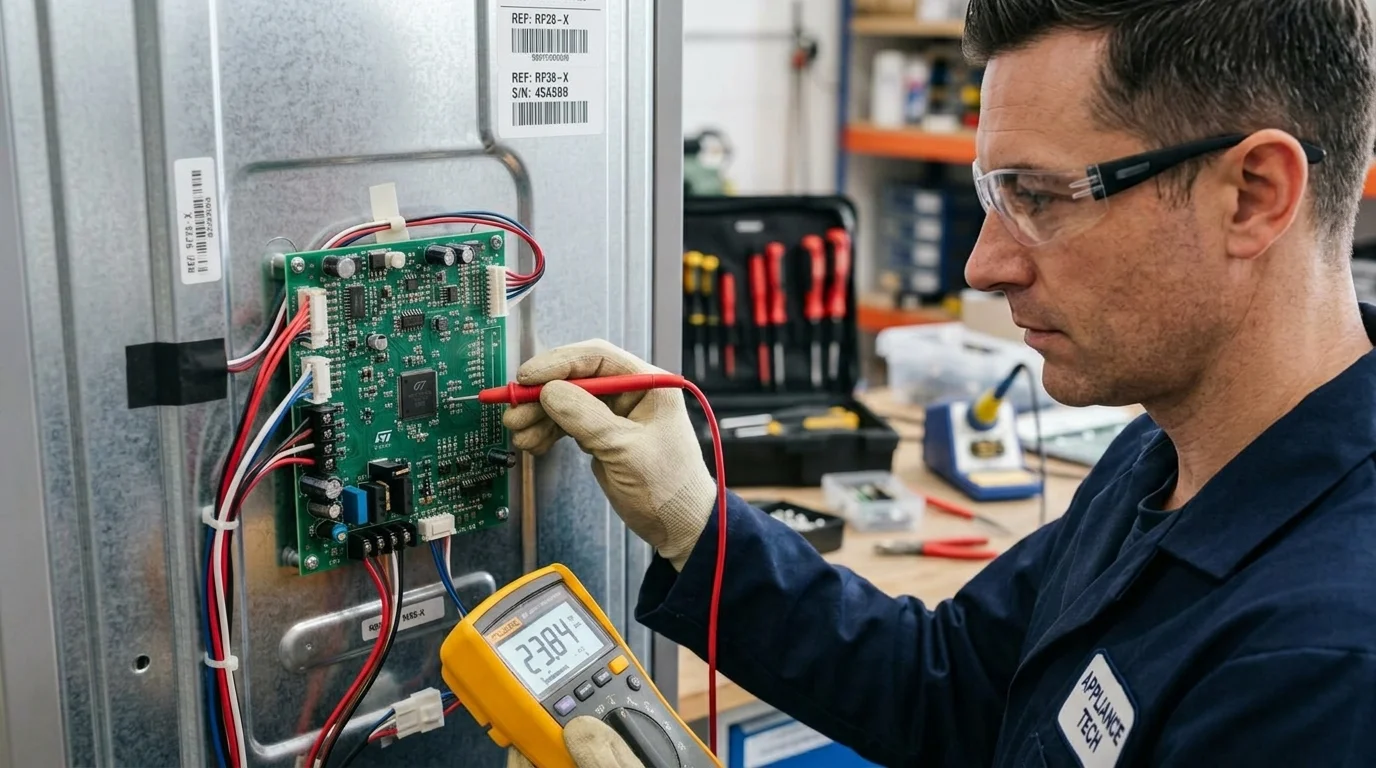
| Failed temperature sensor (thermistor) | Control board thinks the fridge is warm and keeps cooling | $120–$220 |
| Faulty thermostat (older models) | Compressor won't shut off | $120–$220 |
| Control board fault | Wrong temperatures or constant running | $220–$450 |
Food Safety Note
Freezing isn't a safety risk the way warm temperatures are, but it ruins produce, dairy and eggs. The bigger worry is when a failing sensor swings the other way; if you see temperatures above 40°F, move perishables to a cooler or another fridge.
Clearwater Tip
In humid months, people often turn the fridge colder to fight what feels like warmth. If your fridge seems warm near the door but freezes at the back, the cause is usually airflow or a door seal, not the setting. See refrigerator not cooling for the opposite problem.
How the Cold Air Gets Into Your Fridge
In most modern refrigerators there's only one cooling coil, in the freezer. A fan pushes that very cold air (around 0°F) through a duct into the fresh-food section, and a damper opens and closes to let the right amount in. A temperature sensor tells the control board when the fridge is cold enough. If the damper sticks open, or the sensor reads wrong, freezer air keeps pouring in and food near the vent freezes.
Which Foods Freeze First
- Items on the top shelf at the back, closest to the air vent.
- High-water produce: lettuce, cucumbers, celery, berries.
- Milk and eggs stored against the back wall.
- Anything in a crisper drawer set to the wrong humidity.
Brand Notes
| Brand | Common cause of freezing food |
|---|---|
| Samsung / LG | Fridge temperature sensor, damper, or a stuck \"Power Cool\" mode |
| Whirlpool / KitchenAid / Maytag | Air damper assembly or thermistor |
| GE | Damper control or temperature sensor |
| Frigidaire / Electrolux | Damper control or thermostat on older models |
| Older top-freezers | Mechanical thermostat or air-control knob |
When to Call Right Away
If the fridge swings between freezing and warm, or the display temperature doesn't match a thermometer, the sensor or control board is likely failing. That's worth fixing quickly, because the next swing may be warm enough to spoil food.
Related Help in Clearwater
- Refrigerator not cooling
- Samsung refrigerator repair
- LG refrigerator repair
- Freezer frost buildup
- Repair pricing
Frequently Asked Questions
Most often the temperature is set too cold, food is blocking the cold-air vent, or a damper or temperature sensor has failed. Start by setting the fridge to 37°F and moving food away from the vent.
About 37°F, and never above 40°F. The freezer should be at 0°F.
Cold air from the freezer usually enters at the back. Items touching that vent freeze first, even when the rest of the fridge is fine.
Most repairs cost $120 to $300 for a sensor, thermostat or damper. A control board runs $220 to $450.
Fridge Freezing Your Food?
Call for a quick diagnosis and a clear quote before any work starts.
Call (727) 387-0008